
Downtown Brampton water and wastewater capacity improvements
Project updates
The study
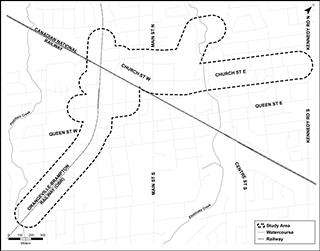
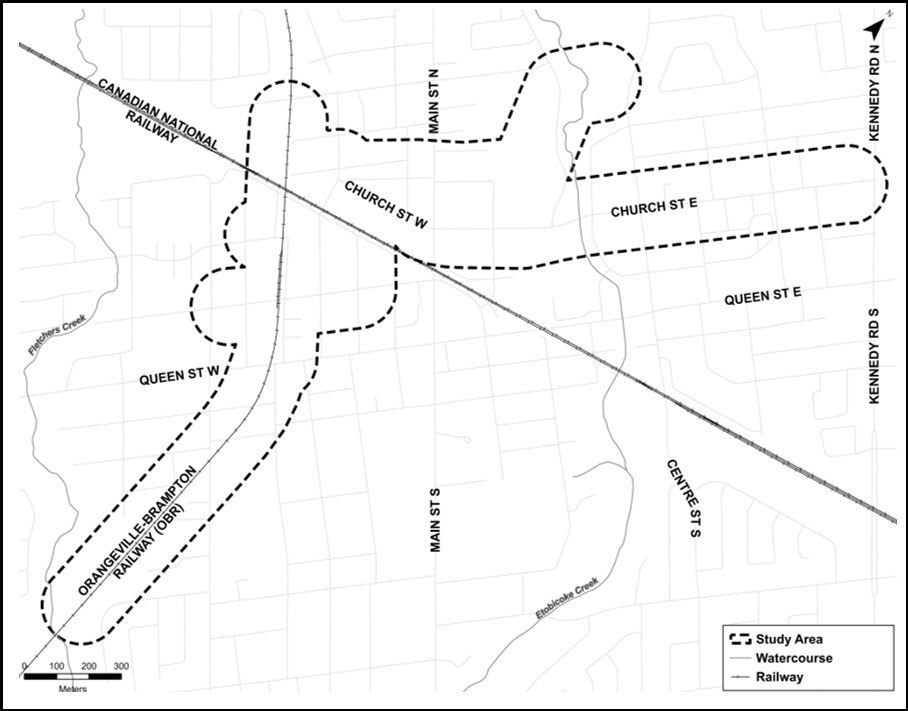
As part of the Flow | Central Brampton Program, and to support the environmental assessment process and preliminary design of the preferred sewer and watermain route options, field investigations will be taking place along the Orangeville-Brampton Railway line from Rosedale Avenue to Fletcher’s Creek Sanitary Trunk Sewer, near Corby Crescent; Church Street East/West from Main Street to Kennedy Road; and Joseph Street/Market Street from the Orangeville-Brampton Railway east through Duggan Park to Centre Street.
Public Information Centre (PIC) 1
PIC 1 was held on March 25, 2026 to provide details about the project and ask questions of the project team members. Refer to the Notice of PIC 1 for details.
Review the presentation boards and take a short survey
Your feedback is important to us. It will help us define the problem and opportunity, confirm how options will be evaluated, and determine the preferred watermain route.
We invite you to explore the presentation boards for more information and complete our survey, available until April 10, 2026.
Background
As part of the Flow | Central Brampton Program, Peel Region is launching the Downtown Brampton Water and Wastewater Capacity Improvements Municipal Class Environmental Assessment Study (Schedule B MCEA). This project will help ensure that the water and wastewater systems can support the additional demand expected from new high-density development planned in the downtown core and along the Queen Street corridor by 2030. The increased capacity of key wastewater trunk sewer and watermain systems will serve the Brampton GO, Centre Street and Kennedy MTSA’s within Downtown Brampton.
About the Downtown Brampton Water and Wastewater Capacity Improvements Project
Flow | Central Brampton was established to build more water and wastewater infrastructure projects, faster, throughout Brampton. Its implementation is in response to the Province of Ontario’s commitment to build 1.5 million more homes in Ontario over the next decade—with 113,000 in Brampton. By adopting a program management approach, the Region of Peel is accelerating the construction of essential water and wastewater infrastructure to meet the needs of both our community and the province. The Schedule B MCEA planning process—divided into three distinct but coordinated studies—will assess and recommend multiple routes for water and wastewater capacity improvements. Following regulatory approval of the Schedule B MCEA, the Project will advance through Preliminary Design, Detailed Design and Construction in three coordinated packages, corresponding to the study groupings as follows:
- Package 1: Downtown Brampton Water Capacity Improvements – 600 mm Major Transit Station Area (MTSA) Watermain;
- Package 2: Downtown Brampton Wastewater Capacity Improvements – Orangeville-Brampton Railway (OBR) Sanitary Trunk Sewer installation; and
- Package 3: Downtown Brampton Wastewater Capacity Improvements – Church Street Sanitary Trunk Sewer installation.
The study area for this Schedule B MCEA will be divided to three distinct packages, refer to Figure 1.
- Package 1 study area: Centre Street North, north of Woodward Avenue, west through Duggan Park to Ken Whillans Drive, south along Ken Whillans Drive, and west along Alexander Street/Market Street to Church Street West at Mill Street/Market Street/Church Street junction.
- Package 2 study area: 1.9 km along the OBR corridor from Rosedale Avenue to Fletcher’s Creek Sanitary Trunk Sewer near Corby Crescent. Additionally, a proposed 600 mm watermain will run on Joseph Street from the Mill Street/Market Street/Church Street junction continuing west to the OBR and running parallel to the trunk sewer within the OBR corridor to terminate at Queen Street. Connections within the OBR corridor to the trunk sewer will also include the following streets:
- Denison Avenue from Park Street to the alignment of the OBR corridor;
- Nelson Street from Elizabeth Street North to the alignment of the OBR corridor;
- Elizabeth Street North from Nelson Street to the existing sewer maintenance hole on Railroad Street; and
- Nelson Street from McMurchy Avenue North to the alignment of the OBR corridor.
- Package 3 study area: Church Street East from Main Street to Kennedy Road. Connections from Church Street will include the following streets as future development-driven sewer connections, but the design and construction of these sewer replacements will not be part of this project scope:
- Scott Street from Church Street to north of Woodward Avenue; and
- June Avenue from Church Street to Queen Street East.
Process
The Schedule B MCEA study will satisfy the two phases of the MCEA process:
- Phase 1: Identify the study problem and/or opportunities; and
- Phase 2: Evaluate and select the preferred route.
A Schedule B Project File Report is expected to be completed and made available for public review at the conclusion of Phase 2 in November 2026.
Your input is important
Community engagement is key to the Schedule B MCEA study process—early discussions will help identify ways to reduce project impacts on residents, businesses, and commuters. Two Public Information Centres (PICs) will be held to present the findings of the Schedule B MCEA study and provide opportunities to give feedback to the project team. Information about the first PIC—planned for Spring 2026—will be provided in late-February in a Notice of PIC. A second PIC will be held in Fall 2026 with similar notification.
Project timeline
The following are target dates for the project:
- Spring 2026: An in-person and virtual PIC will be scheduled to: introduce the Project; and provide background information, the problem and opportunity statement, and associated evaluation methodology and criteria, and route options. There will be an opportunity to virtually provide feedback over a two-week time frame.
- Fall 2026: A second PIC will be held to present the evaluation of the route and shaft location options including the recommended options, along with the potential impacts and proposed mitigation measures for review and comment.
- Winter 2026: Once the study is complete, results will be published in a Schedule B MCEA Schedule B Project File Report and will be made available for public review and comment.
- Fall 2026 – 2029: Detailed design, tender and approvals. Construction is anticipated to start in 2028-2029 depending on each package.
Get involved
Contact the team if you have comments, questions, concerns or would like to be added to the project mailing list:
Nadeem Dean
Project Manager, Environmental Assessment & Infrastructure Planning & Studies
Peel Region
Phone: 647-248-3785
Paul Adams, CPT
Environmental Planner, AECOM
Phone: 519-636-6448