
Food safety special event guidelines
Vendors must follow the requirements in O. Reg. 493/17: FOOD PREMISES Regulation (ontario.ca) under the Health Protection and Promotion Act, as well as Food Premises Reference Document, 2019.
This guidance does not replace the requirement for organizers to ensure that all local and municipal permits or application processes for an event are completed as required.
To reduce public health risk, special event organizers must complete and submit a:
- Special event organizer application at least 30 days before the event.
- Special event food vendors application at least 15 days before the event. Learn about other public health risks and how to prevent them:
- For personal services (such as tattoos, ear or body piercing, manicure or pedicure, etc.), see the personal services guidelines for special events.
For petting zoos, refer to the recommendations and best practices for petting zoo and other animal attraction operators.
For henna and face painting, refer to the henna and face painting guidelines for special events.
A Peel Public Health Inspector will review your application and contact you to discuss food safety requirements related to the foods you are planning to serve. Before food can be served at a special event, the Public Health Inspector must verify that the following requirements are met:
- All food must be obtained from an approved source.
- All food must be prepared in an inspected and licensed food premises.
- Home prepared foods are not allowed unless the home where the food is prepared has been inspected by a public health inspector.
- Unpasteurized food products and beverages are not sold or given away as samples.
- A designated handwashing station with running hot and cold potable water is available at each booth.
Contaminated foods or food with a temperature in the danger zone will be discarded. Refer to general food safety definitions for details about the danger zone.
Municipal permits
Check with your local municipality for license or permit requirements for your special event. They will have specific requirements for fire prevention and wastewater and garbage collection.
The danger zone
The temperature zone where bacteria multiply is called the “danger zone”. This temperature range is between 4 C and 60 C (40 to 140 F).
If food items are kept within this temperature range, bacteria will multiply and double every 20 minutes. It’s important to keep the food cold or hot, and out of the danger zone to stop bacteria from growing. An accurate probe thermometer should be used to check the internal temperatures of hazardous food. All temperature-controlled compartments, such as a cooler or hot holding unit must be equipped with a thermometer.
Cross contamination
Cross-contamination occurs when safe-to-eat food has become contaminated with pathogenic bacteria, chemicals, or unwanted items. Prepared food items can become unsafe when they come in contact with surfaces, utensils, hands, equipment, and other food items that are dirty.
Hazardous food
Hazardous food consists in whole or in part of milk or milk products, eggs, meat, poultry, fish, shellfish, or other products that can support the growth of disease-causing bacteria. Examples are deli meats, all raw meats, poultry, sausage, fish, eggs, cheese, cream-filled pastries, etc. meringue and other desserts containing dairy products. Hazardous food must be stored at 4 C (40 F) or less.
Fruits and vegetables, which are generally considered low risk foods, can still become contaminated through improper food handling or production processes. Be sure to follow safe food handling practices and thoroughly wash fresh fruits and vegetables before preparation.
Non-hazardous food
These foods do not normally support the growth of disease-causing organisms and do not usually need to be refrigerated. Examples are cookies, breads, cakes, potato chips, popcorn, and nuts.
- There must always be at least one certified food handler on site at each vendor while the event is open to the public.
- Have photo identification and a copy of the certificate on site.
- For more details about food handler certification, refer to information for food operators.
- If food handlers are ill with a cold, the flu, diarrhea, vomiting, or any communicable disease, or have sores or cuts, do not handle food. These food handlers are encouraged to stay home and not attend the event.
- Clean outerwear is required when handling food.
- Hair must be adequately confined while handling food.
- Glove use is not mandatory unless the food handler has a cut or burn. Gloves must be changed in between tasks. Hands must be washed before putting new gloves on and after taking off dirty gloves.
Smoking and vaping is not permitted within the booth or wherever food is stored, prepared, and served. Food handlers must adhere to the Smoke-Free Ontario Act, 2017 and Peel Region’s Outdoor No Smoking or No Vaping By-Law.
Design your booth with food safety in mind. All food must be protected from contamination. Ensure barriers are in place to protect food contamination. This includes sneeze guards, physical barriers, plastic wrap etc.
Only food handlers may be permitted inside the food preparation area. Children and animals are not allowed in your booth. The more your food is exposed to people, the greater the likelihood of contamination.
No home prepared food is allowed to be sold or distributed unless the home has been inspected by the public health department and proof has been obtained of the inspection. Your public health inspector may require and ask for receipts or proof of the premises in which the food was prepared.
The public health inspector can ask for this information on site. If you are unable to show proof of the source of your food items, a public health inspector may force you to close your booth or discard any questionable food.
Keep your menu simple, and keep hazardous foods (e.g., meat, eggs, dairy products, cut fruit and vegetables, etc.) to a minimum.
Meat, poultry, dairy products, and eggs must be obtained from an approved inspected source and not directly from the farm. Selling unpasteurized milk and ungraded eggs is illegal.
- Have and use an internal probe thermometer to check the internal temperatures of hazardous foods (meat, rice, eggs, dairy, etc).
- Hazardous foods should be cooked to at least 74 C (165 F). Refer to the cooking and reheating hazardous foods poster.
- All food being stored, prepared, displayed or transported to the site must be protected against contamination from dust, insects and other sources. Provide adequate protection by covering food entirely with a lid, food- grade plastic wrap, aluminum foil, sneeze guards or other food grade material.
- Hazardous food must be transported, stored, and maintained at required temperatures. Cold foods must be kept at 4 C (40 F) or less, hot foods at 60 C (140 F) or more and frozen foods must be kept frozen. Access the safe food temperatures poster.
- Many foodborne illnesses happen after people eat hazardous foods that have been left out at room temperature for 2 hours or more – in the danger zone. Refer to general food safety definitions for details about danger zone.
- Hazardous food in the danger zone, from 4 C to 60 C, (40 to 140 F), supports the growth of harmful bacteria which can multiply and cause food spoilage and foodborne illness.
- Thermometers must be provided in all coolers or refrigerators and hot holding units to ensure safe food temperatures.
- Use cold or hot packs in thermal insulated containers, coolers, or mechanical refrigerator units to transport and store food at the event. This will ensure your food remains at the required temperatures during the duration of the event.
- Store food in fully enclosed plastic containers which are insect, rodent and waterproof and have a tight-fitting lid.
- Plan for a possible power failure by having a backup generator or extra coolers, ice, sternos, chafing dishes etc.
- Access the temperatures for cooking and reheating hazardous foods poster.
Handwashing
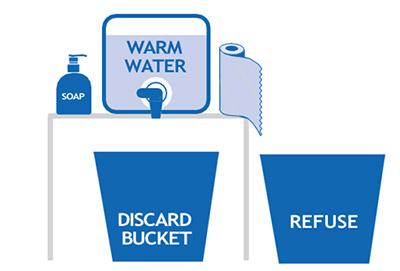
A designated handwashing station with running hot and cold potable water must be available for each booth.
The handwashing station must be kept inside the booth, close to food handling and be accessible to food handlers while preparing food.
If a proper sink with plumbing is not available, a large container of warm water with a spigot (e.g., a coffee urn with a spigot), a liquid soap dispenser, a roll of paper towels and a bucket to collect wastewater must be available for use while preparing and serving food.
Additional handwashing information
- Any booth that does not have a proper handwashing station will be closed and not allowed to operate.
- The use of gloves does not replace handwashing.
- All food handlers must wash their hands with clean warm water and liquid soap before starting work, after each visit to the toilet, after smoking, handling garbage, handling cash and as frequently as possible to maintain clean hands.
- Hands must be thoroughly washed especially when they become contaminated by touching raw meat and poultry and before handling ready-to-eat food.
- Alcohol based sanitizers are not permitted as a substitute for hand washing.
Cooking hazardous food
Use a food thermometer to check internal cooking temperatures for hazardous foods (for a minimum of 15 seconds).
The food must be cooked to the following minimum internal temperatures:
- Chicken - whole 82 C (180 F)
- Chicken pieces (wings, legs, breast) 74 C (165 F)
- Pork 71 C (160 F)
- Hamburger 71 C (160 F)
- Fish 70 C (158 F)
- Other (e.g., lamb, steak) 60 C (140 F)
Refer to temperatures for cooking and reheating hazardous foods poster.
Re-heating previously cooked food
- If you are bringing food to the event that has already been cooked, you must reheat the food to 74 C (165 F) before placing it in the chafing dish or other hot holding unit.
- When reheating, ensure proper equipment is on site. For example, a microwave, burner or BBQ.
- Use an internal probe thermometer to ensure the proper temperature has been reached after being reheated.
Displaying and serving food
- Since people may cough, spit or touch your food (potentially causing a foodborne illness), have a physical barrier to protect your food.
- Cover your food at all times by using a lid, food-grade plastic wrap, aluminum foil, sneeze guards or other food grade material.
- Condiments must be offered in individual packages or dispensed from containers that protect the condiments from contamination (for example, squeeze bottle, pump).
- Hazardous foods must be held at a minimum of 60 C (140 F).
- Food must be stored in their original containers or in food grade containers. Cardboard boxes, garbage bags, reused plastic buckets or pails are not acceptable.
- Food and related items such as cutting boards and serving utensils should not be stored directly on the floor or ground.
- Do not mix old food with new food when replenishing service pans or chafing dishes.
Food handling
- Use separate worktables or cutting boards to cut raw and ready-to-eat foods to prevent cross-contamination.
- Use utensils (e.g., tongs, ladles, forks, spoons) to minimize direct contact with food.
- When gloves are used, they must be changed in between tasks and hands must be washed before putting on a new pair and after taking off a dirty pair. Washing gloves is not acceptable.
- Gloves are single use only. Once you take them off, they must be put into the garbage and not be used again.
- Ensure that proper hand washing procedure is followed. Refer to the handwashing poster.
Food utensils and equipment
Cleaning and sanitizing
- Where only serving utensils are used, a 2-compartment sink is required. Equipment is to be washed and rinsed in the first sink and sanitized in the second.
- If a 2-compartment sink is not available for washing and sanitizing utensils (spoons, tongs, ladles, ice cream scoops), have a sufficient number of clean back-up utensils in case the original utensils get contaminated. Do not use utensils that have fallen on the ground.
- Where multi-use utensils (i.e., reusable dishes served to patrons) are used, a 3-compartment sink is needed. Utensils are to be washed in the first sink, rinsed in the second sink with clean water, and sanitized in the third sink.
- A sanitizing solution of 100ppm chlorine bleach (2 ml, half a teaspoon of chlorine per 1L water, 4.23 cups), 200ppm quaternary ammonium or 25ppm iodine is needed. Immerse utensils for at least 45 seconds. Air dry or wipe dry with a disposable towel.
- Change the wash, rinse and sanitizer water frequently. Use sanitizer test strips to check sanitizer concentration.
- Other sanitizers may be used if approved by Peel Public Health. Follow the manufacturers’ instructions, with the sanitizer having the proper concentration.
- Ensure all containers (bucket or spray bottle) of soap or sanitizer solutions are properly labelled and kept away from food.
- Water must be from an approved safe supply.
- You may use tubs or basins as a temporary method if sinks are not available during the event. Consult with your public health inspector before incorporating this temporary method.
- Dispose of wasterwater in a sanitary manner. Organizers must ensure there is an area for proper disposal of wastewater from hand wash basins and cleaning equipment sinks.
- Single service eating utensils such as plastic knives, forks, spoons, paper plates and cups should be provided.
Food contact surfaces
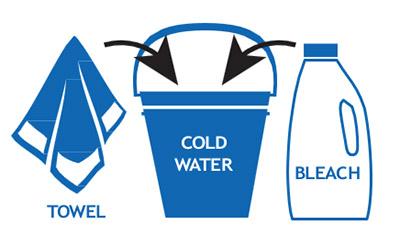
Wiping cloths or sponges for cleaning and sanitizing food contact surfaces must be stored in a sanitizing solution between uses. A sanitizing solution of 100ppm chlorine bleach (2 ml, half a teaspoon of chlorine per 1L water, 4.23 cups), 200ppm quaternary ammonium or 25ppm iodine is needed.
A sanitizer in spray form or a sanitizing bucket must always be available to sanitize work surface areas throughout the time of the event. During an inspection, an inspector will check to see if you have sanitizer. They will also check the sanitizer’s concentration levels.
Water source
All water used throughout the event, including water used for hand washing, preparation of foods, cleaning and making ice, must be potable, drinkable and from an approved source. Accepted supplies are a municipal water source or commercially bottled water.
Potable (safe) water under pressure or gravity fed must be used, with sufficient supply for hand washing, food preparation and equipment cleaning the entire time that the event is operating.
When a sink or hand wash basin is not available, a clean water container must be used (e.g., plastic jug with spigot).
Ice
- All ice must be made from potable (safe) water or from an approved source.
- Ice must be transported, stored and handled in a sanitary manner.
- Ice used in coolers to keep items cold must not be used in beverages or other foods.
- Ice must be stored in closed containers or bags to prevent contamination.
- Tongs and scoops used to dispense ice must not be stored directly inside the ice container. Store them in a clean container beside the ice.
- Never let your hands come into direct contact with ice.
- Ice is considered a ready-to-eat food product and can become contaminated with bacteria and viruses which may cause food-borne illness.
Health and hygiene
- If you are sick, do NOT work with food.
- If you have a fever, nausea, diarrhea, vomiting, or jaundice (yellowing of the skin) or if you have open sores or infected cuts on your hands, you must not handle, prepare or serve food. Hands can be protected from minor cuts with gloves.
- Clean outerwear is required.
- Hair restraints (e.g., hairnet or cap) must be worn when handling food.
- Smoking or vaping is not permitted in your food preparation area at any time.
Waste disposal and washroom facilities
- Garbage is to be stored in bins of durable, water and rodent proof material and covered with a tight-fitting lid.
- Grease from fryers must be stored in a covered, non-flammable and durable container.
- Wastewater shall be stored in a covered, durable container.
- All wastes must be disposed of in an approved and sanitary manner.
- Organizer must ensure there is a plan for waste disposal and washroom facilities.
Organizer
- Washroom facilities for use by the public shall be provided in sufficient numbers, conveniently located, and maintained in a sanitary manner.
- Organizers should also consider the availability of accessible washrooms.
- Handwashing stations must have a constant supply of hot and cold or warm potable water, liquid soap in a dispenser, and single use paper towels during the event.
- It is not adequate to only have hand sanitizer at washroom facilities.
Mobile food trucks and carts with a fixed address in Peel are required to have one inspection prior to operating their vehicle.
Public health inspectors check for all the same food safety requirements in a mobile food truck as they would in a permanent facility. Water supplies, temperature control, dishwashing, prevention of contamination and many other food safety measures are monitored by public health inspectors. Mobile food trucks may require a license if they choose to operate within a Municipality and not only at a special event.
If food prep happens outside of the food truck, a handwashing sink is required in that area as well. Hot and cold running water for handwashing, cleaning and sanitizing is necessary.
These are the specific requirements for street food vending carts:
- Customers must use only single use items such as disposable forks, knives and spoons.
- Overhead canopy: While in operation, must be completely covered by an overhead canopy of corrosion-resistant, non-absorbent and readily cleanable material.
- Clean water: Must have adequate clean water to allow for sanitary operation and hand washing. The water supply tank must be equipped with an easily readable gauge for determining the water level in the tank.
- Waste water: Must have a waste water holding tank with an easily readable gauge to collect waste generated during the operation of the street food vending cart.